
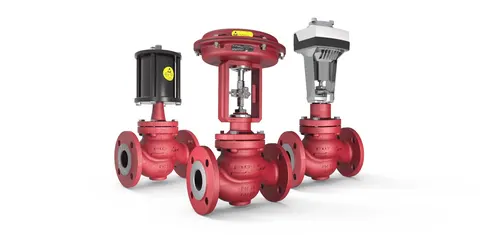


POSITIONER
Control Valve Positioners: The Smart Control Layer of the Valve
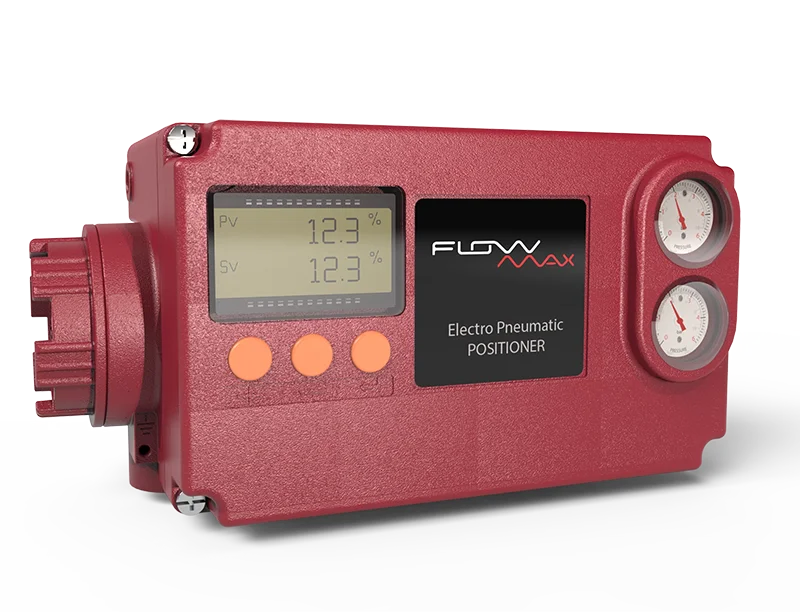
A control valve is the “muscle” of a process, while the controller (PLC/DCS) serves as the “command center.” The critical equipment that
ensures these commands are applied accurately and repeatably to the valve under conditions such as friction (stiction), varying line pressur
e, and changing load conditions is the positioner.
A positioner enables the valve to reach its target position quickly, stably, and precisely, significantly improving the reliability of the control loop.
What Does a Positioner Do?
A positioner performs closed-loop control between the control signal and the actual position of the valve:
Receives the signal: 4–20 mA (or pneumatic signal)
Measures and compares the position: Compares the desired position with the actual valve position
Corrects the error: Increases or decreases the air supplied to the actuator to eliminate the position error
As a result, the valve can maintain precise positioning and more stable control even when mechanical effects and process loads in the field change.
The Contribution of Standardization: IEC 60534-6
The key to ensuring compatibility between valves and positioners from different manufacturers in the field is the standardization of mounting and connection interfaces. IEC 60534-6 helps establish common mounting and connection principles for positioner mounting kits.
This approach simplifies field integration, increases sourcing flexibility, and accelerates maintenance processes.
Technology Options: From Pneumatic to Digital
Positioner technology can generally be classified into three main categories:
Pneumatic (P/P): A simple and robust design; however, air consumption and precise adjustment capabilities may be limited.
Electro-Pneumatic (I/P): Converts a 4–20 mA signal into pneumatic control, providing a widely used solution in industrial applications.
Digital “Smart” Positioners: In addition to position control, smart positioners offer capabilities such as diagnostics, automatic calibration (Auto-Cal), and predictive maintenance, contributing to improved operational continuity.
A Critical Point in Calibration: Feedback Arm Adjustment
One of the factors that most frequently affects performance in the field is not simply the “zero/span” adjustment, but the geometry of the feedback mechanism.
For proper linear behavior, when the valve is approximately 50% open, the feedback arm should be positioned at the reference angle recommended by the manufacturer—typically close to horizontal in many systems. This significantly improves control stability.
Incorrect feedback arm geometry can cause the valve to behave non-linearly and result in unstable control.
Quick Checklist for Field Troubleshooting
When diagnosing positioner-related problems, a practical approach is to perform a few basic checks:
-
Is there a signal? (Is the 4–20 mA signal/command being received?)
-
Is the air supply sufficient? (Pressure, filter-regulator, leaks)
-
Is the mounting/linkage secure? (Mechanical connections, looseness, damage)
-
Are the settings excessive? (Gain/balance settings, unnecessarily aggressive tuning)
-
Is the mechanical resistance normal? (Is the packing too tight? Has friction increased?)
Conclusion
A positioner is not merely an “accessory”; it is a fundamental component that ensures the accuracy and stability of the control loop.
In particular, digital smart positioners help reduce the risk of unplanned downtime by providing diagnostic and predictive maintenance capabilities in addition to precise control.